Physics
-
Looking Back
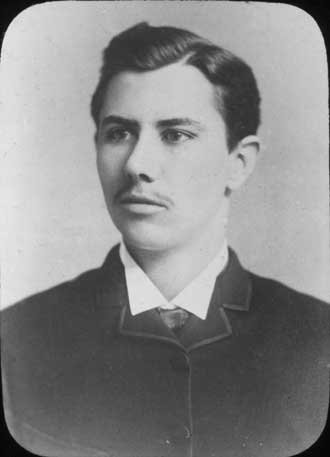
The result of one of John Daniel's early experiments: X-rays of the hands of three generations of one family, circa 1900. (image courtesy of Vanderbilt University Special Collections & University Archives) Following German physicist Wilhelm Röntgen’s discovery of X-rays in late 1895, scientists around the world began experimenting with the… Read MoreFeb 1, 2012
-

Discovery of the smallest exoplanets: The Barnard’s star connection
The smallest exoplanets yet discovered orbit a dwarf star almost identical to Barnard’s star, one of the Sun’s nearest neighbors. The similarity helped the astronomers calculate the size of the distant planets. Read MoreJan 11, 2012
-
Failure to find ‘God particle’ hints at fundamentally new physics
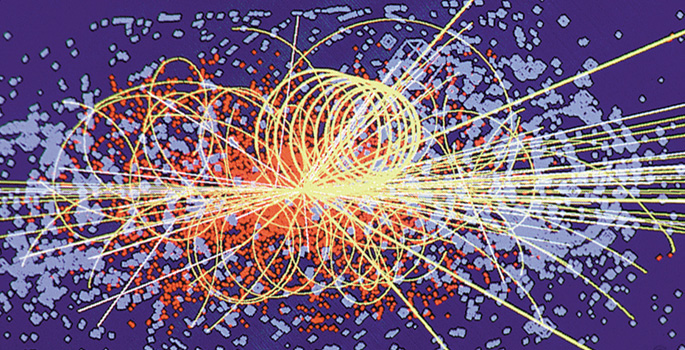
Vanderbilt's virtual control room for the CMS detector that allows scientists and students to participate in meetings, monitor the experiment and analyze the data that it produces (John Russell / Vanderbilt University) After the most complete search yet, the world’s largest atom smasher, the… Read MoreNov 21, 2011
-

Kudos
Greg Barz (Vanderbilt) Greg Barz, associate professor of ethnomusicology, has co-edited a volume of essays, The Culture of AIDS in Africa: Hope and Healing Through Music and the Arts, published by Oxford University Press. Anne Davis, instructor in law, has been named managing attorney of the Southern Environmental Law… Read MoreNov 1, 2011
-

Robot biologist solves complex problem from scratch
A team of scientists has taken a major step toward developing robot biologists. They have shown that their system, the Automated Biology Explorer, can solve a complicated biology problem from scratch. Read MoreOct 13, 2011
-
Taking introductory astronomy beyond Jeopardy and Trivial Pursuit
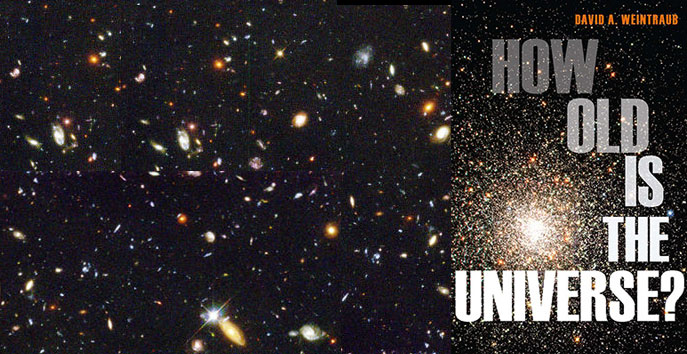
Astronomer David Weintraub has given introductory astronomy a “CSI” format by following the scientific evidence that gives us the age of the universe and has put this in a popular science book. Read MoreOct 7, 2011
-

Erin Rericha
Interfacial scientist thrives on moment of discovery Erin Rericha (Lauren Owens/Vanderbilt) Erin Rericha considers herself an interfacial scientist. The new assistant professor of physics explained that she has “a bit of a split personality.” “I am trained as a condensed matter physicist,” she said, “and I spent… Read MoreOct 3, 2011
-

-
Stamping out low cost nanodevices
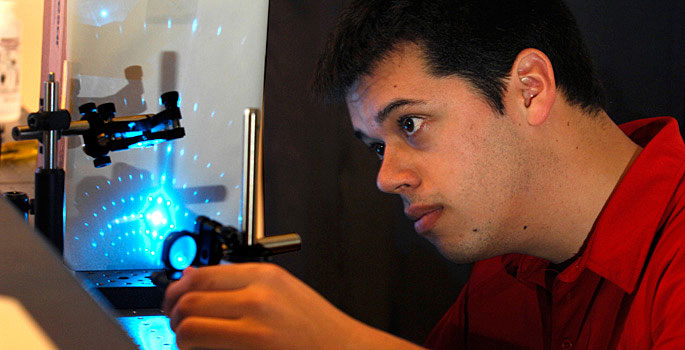
A team of Vanderbilt engineers have developed a rapid and low-cost imprinting process that can stamp out a variety of devices that have unique optical, electrical, chemical and mechanical properties. Read MoreMay 31, 2011
-
Beyond knot theory
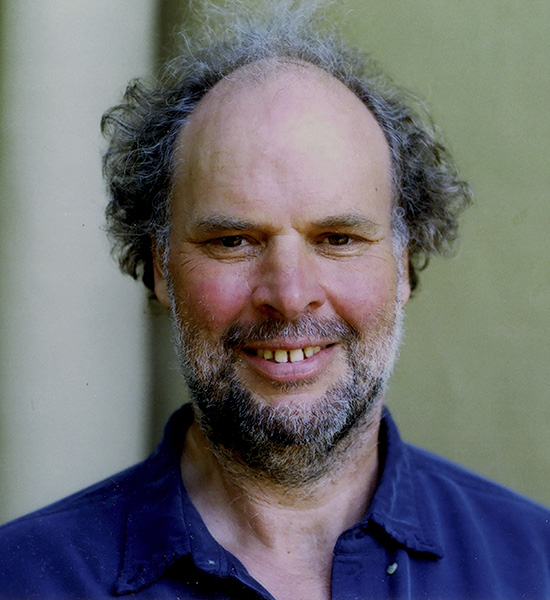
I’ve always been fascinated, and occasionally frustrated, by the tendency of string, yarn, rope and wire – any thing that is long, thin and flexible – to knot and tangle. Fields Medal winner Vaughan F.R. Jones Clearly, I’m not the only one. Mathematicians have been studying knots… Read MoreApr 14, 2011
-

Big Bang or Big Bounce?
There is a new dark-horse entry in the cosmological sweepstakes. Cosmologists Alan Guth, left, and Paul Steinhardt In the last 50 years, the Big Bang theory has gradually become the standard scientific model for how the universe began and has been written into the grade school science… Read MoreApr 5, 2011
-
Inflationary cosmology on trial
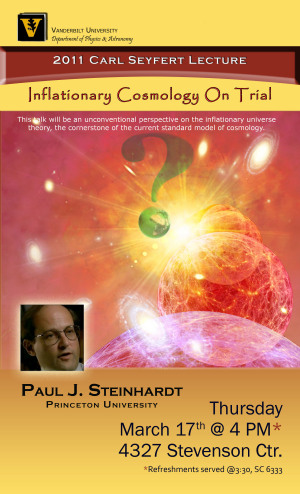
Watch video of the Seyfert Lecture featuring Dr. Paul J. Steinhardt, the Albert Einstein Professor in Science and director of the Princeton Center for Theoretical Science at Princeton University. Steinhardt, who is also on the faculty of both the Department of Physics and the Department of Astrophysical Sciences, spoke at Vanderbilt… Read MoreMar 21, 2011
-
Large Hadron Collider could be world’s first time machine
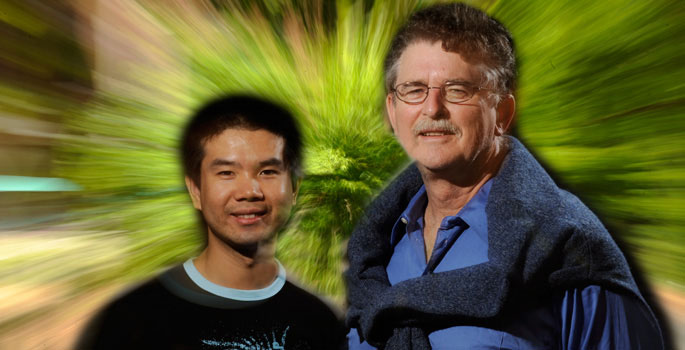
Prof. Thomas Weiler, right, and graduate fellow Chui Man Ho (John Russell / Vanderbilt) If the latest theory of Tom Weiler and Chui Man Ho is right, the Large Hadron Collider – the world’s largest atom smasher that started regular operation last year – could be… Read MoreMar 15, 2011
-
Future of the Parable of the Lost Sheep
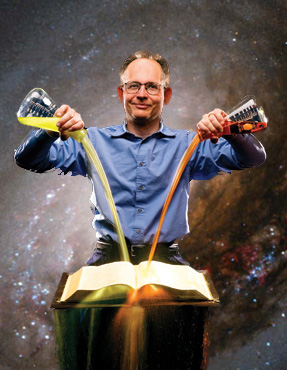
Vanderbilt physicist Robert Scherrer supplements his scientific research with writing science fiction stories. Bob Scherrer is bicultural: Not only is he a practicing theoretical physicist, but the chairman of Vanderbilt’s physics department is also a published author of science fiction. Several years ago we did a… Read MoreMar 3, 2011
-
Tuning graphene film so it sheds water
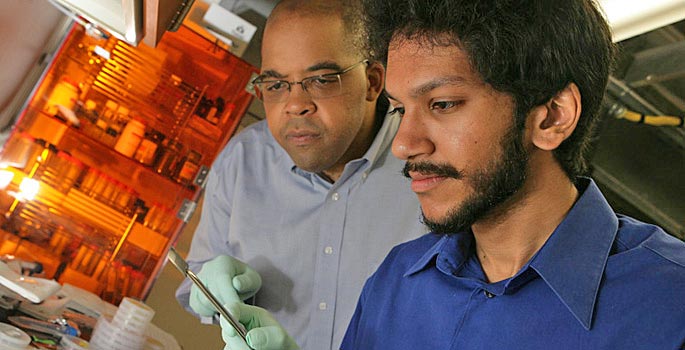
Physicist James Dickerson, left, and graduate student Saad Hasan (Photo by Daniel Dubois) Windshields that shed water so effectively that they don’t need wipers. Ship hulls so slippery that they glide through the water more efficiently than ordinary hulls. These are some of the potential applications for graphene, one of… Read MoreFeb 1, 2011
-
Vanderbilt’s role in largest digital sky image
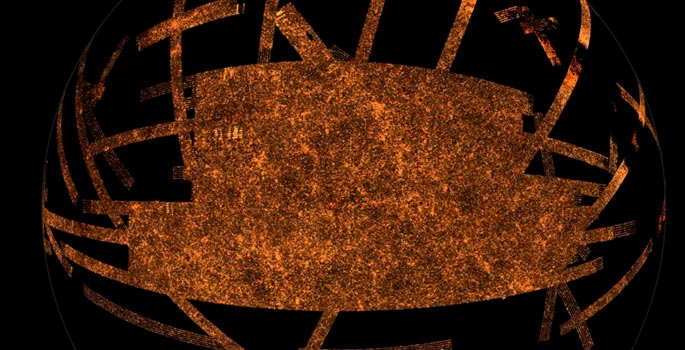
The Sloan Digital Sky Survey-III collaboration, which includes Vanderbilt University, has resulted in a picture of the sky so big that it would take 500,000 high-definition TVs to view it at full resolution. The color image contains more than a trillion pixels and covers about one-third of the entire sky. Read MoreJan 13, 2011