By Jenna Somers
In February, faculty members from Vanderbilt Peabody College of education and human development participated in the National Conference on Education, presented by AASA, the School Superintendents Association, held in Nashville, Tennessee. This annual conference brings together district leaders from across the country to engage with leading education experts and access tools and resources to strengthen public education.

Professor Ellen Goldring summarized prior research on principle pipelines as a promising, affordable strategy for tackling school leadership challenges, including leadership turnover, declining interest in the profession and teacher shortages, drawing on evidence from the Wallace Foundation-funded Principal Pipeline Initiative.
Goldring offered a framework for principal pipeline sustainability based on insights from the Principal Pipeline Learning Community, which includes 84 districts and case studies of 16 districts. This research asked, what characterizes districts that continue to sustain principal pipelines, in turbulent and changing district contexts?
The framework emphasizes building sustainability into the change process from the outset and proceeding through four phases: creating readiness for sustainable change, initial implementation, institutionalization and ongoing evaluation and renewal. Four dimensions of sustainability exist across these phases: strategic alignment to district goals, clarity of intent from leaders and reinforced by a pipeline champion, institutional elements like dedicated leadership roles, and maintaining priority through strategic plans and using data to adapt and improve the pipeline.
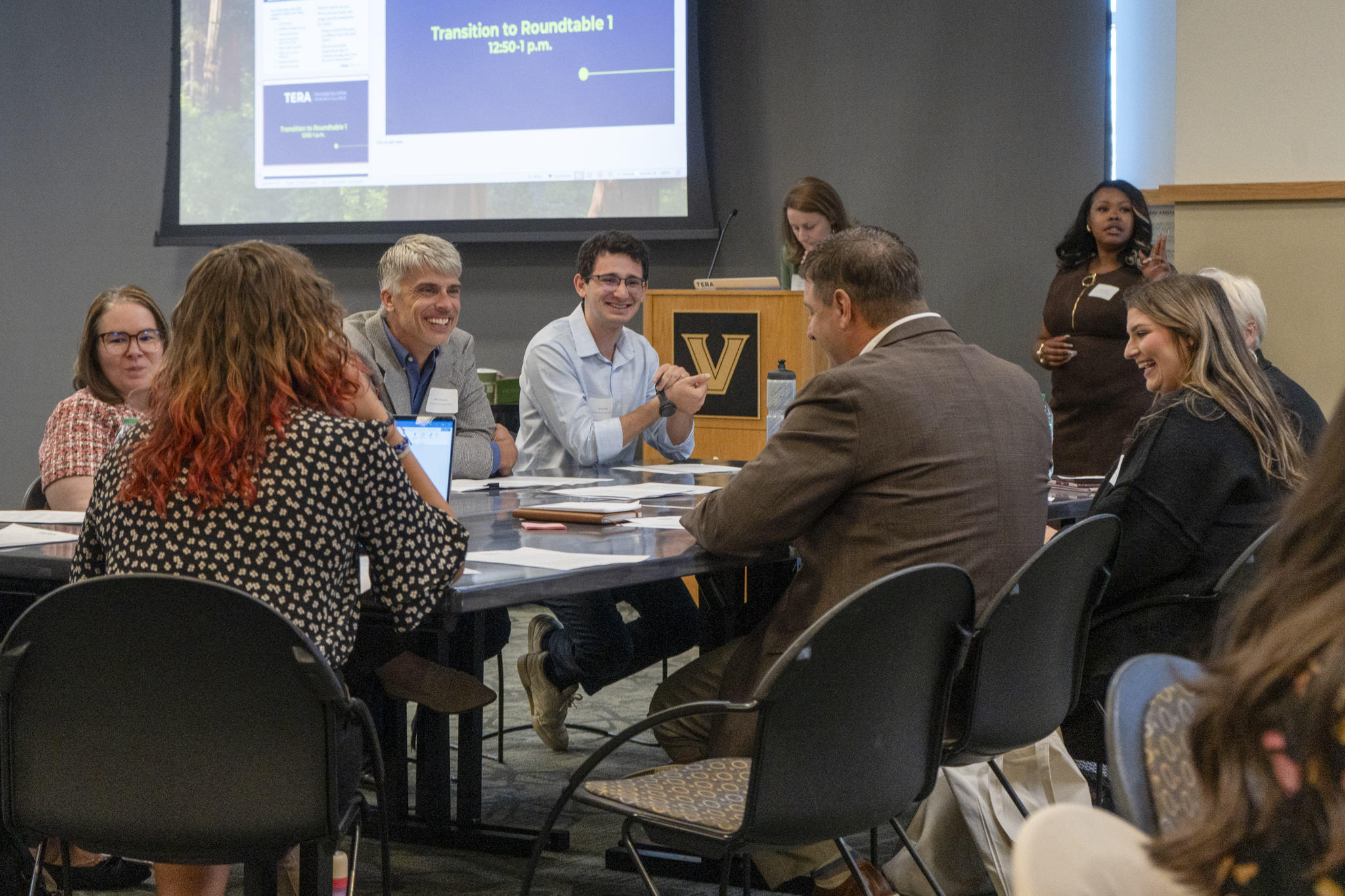
Goldring engaged further on the topic of sustaining principal pipelines in a panel discussion with school district leaders Timisha Barnes-Jones, chief of schools, Winston-Salem/Forsyth County Schools, North Carolina; Burke Royster, superintendent, Greenville School District, South Carolina; and Tony Watlington, Sr., superintendent, Philadelphia School District, Pennsylvania, as well as Rotunda Floyd-Cooper, vice president of the Wallace Foundation.


Peabody Professor Jason Grissom also addressed the National Conference on Education, discussing how leadership pipelines develop effective principals who strengthen student outcomes and improve schools. This discussion highlighted results from a major report he led for the Wallace Foundation that synthesized the practices of effective principals from two decades of empirical research.
His remarks introduced a conversation among three superintendents developing leadership pipelines in their districts in Nashville, Tennessee; Portland, Oregon; and San Antonio, Texas. “It was fascinating to hear how each district was approaching the work of preparing and supporting school leaders to engage in the practices research says are key, including evidence-based feedback and coaching, investing in strong school climates, and managing school resources strategically,” Grissom said.
The Learning Environments Action Research Network (LEARN) symposium, held in Nashville in conjunction with the National Conference on Education, featured presentations by Peabody Professors Sean Corcoran and Marisa Cannata.

Corcoran discussed the decline in public school enrollments amid growing school choice, suggesting that public schools can compete by leveraging advantages, such as higher accountability standards, engaging in community outreach and offering choices of their own to families, such as specialized courses and programs.
Cannata addressed the use of improvement science in education. Improvement science is a system-focused problem-solving approach centered on continuous study and learning. Cannata spoke about how districts might change their approach to improvement initiatives to more effectively implement and sustain educational change.
Across both conferences, Peabody faculty engaged meaningfully with school district leaders on the importance of grounding district improvements in rigorous research and data, ensuring that they have access to evidence-based frameworks and best practices.