
By Jenna Somers
After a hard day of work, a parent reading a bedtime story to their child might feel too tired and stressed to think of questions that could spark insightful conversations about the story with their child. But these conversations—which scholars call dialogic reading—are critical to literacy development. They strengthen children’s reading comprehension and vocabulary, as well as their love of reading. What if there was a mobile app that could help these families?
That is what a research team at Vanderbilt University is developing. The REED app leverages generative AI to listen to a caregiver reading to a child, tracks where they are in the story, and then suggests real-time, open-ended prompts to encourage dialogue between the caregiver and child. REED stands for read, engage, explore, and discuss, which describes the process of dialogic reading. The app generates prompts based on the child’s age, preferred language, and whether the book is new to them or an old favorite.


Amy Booth, professor of psychology and human development at Peabody College, Abbie Petulante, PhD’22, a post-doctoral fellow at Vanderbilt Data Science, and Margaret Shavlik, PhD’23, a post-doctoral researcher in early literacy interventions, have developed a prototype of REED and are working with the Vanderbilt Center for Technology Transfer and Commercialization to bring the app to market via their new business, COG Learning. The name COG Learning reflects the team’s motivation for creating the mobile app—to Close Opportunity Gaps in the availability of support for early learning across the differing experiences and skills of young children.


“Many early literacy interventions are unfortunately not equally effective for kids who need them the most, so we are figuring out ways to close the gap,” Booth said. “We know that back-and-forth conversations between a caregiver and a child are a powerful engine for early learning, so we intentionally designed the app to be parent focused and minimally intrusive. Rather than providing a conversational agent, the app shows the prompt to the caregiver who then asks the child the question. There has been a lot of enthusiasm for the app among the 60 or so families who have tried it out so far.”
Earlier this year, the CTTC awarded the team their second round of support from the Innovation Catalyst Fund. The team has also received funding from the Peabody Dean’s Office, a Spark Research Grant from the LIVE Learning Innovation Incubator, a VU Generative AI Seed Grant from Research Development and Support, and a grant from the Dollar General Literacy Foundation. After completing the regional NSF I-Corps program led by Vanderbilt’s Wond’ry, they were awarded a grant from the NSF to participate in the national NSF I-Corps program. An IBM grant to Vanderbilt Data Science is further funding REED’s model development through the Data Science for Social Good program.
These investments reflect the promise and potential of the REED mobile app to leverage AI in support of children’s literacy development. At Vanderbilt Data Science, Petulante leads the development of the large language model that will generate developmentally appropriate conversation prompts for any book. She will serve as the CTO at COG Learning.
“The technology behind REED shows how we can leverage domain-specialized AI to make a real impact. By teaching the model to mirror real human expertise, we’re able to put that expertise into every caregiver’s pocket,” Petulante said.
Shavlik is analyzing the effectiveness of the mobile app for fostering dialogic reading and its downstream effects on vocabulary, story comprehension, narrative skill, and other literacy measures. She is also taking the lead in commercialization efforts for COG Learning and will be the company’s CEO.
“I’m excited to be part of something that we hope ignites a love of reading for both children and the adults who read with them,” Shavlik said. “Interactive book reading doesn’t just build vocabulary and comprehension; it also supports attention, self-regulation, and perspective-taking, all while strengthening the caregiver–child bond. With REED, we’re working to make those rich interactions easier to spark—and through COG Learning, we’re taking this work beyond the lab and into families’ everyday lives.”
https://doi.org/10.1016/j.ecresq.2019.02.009
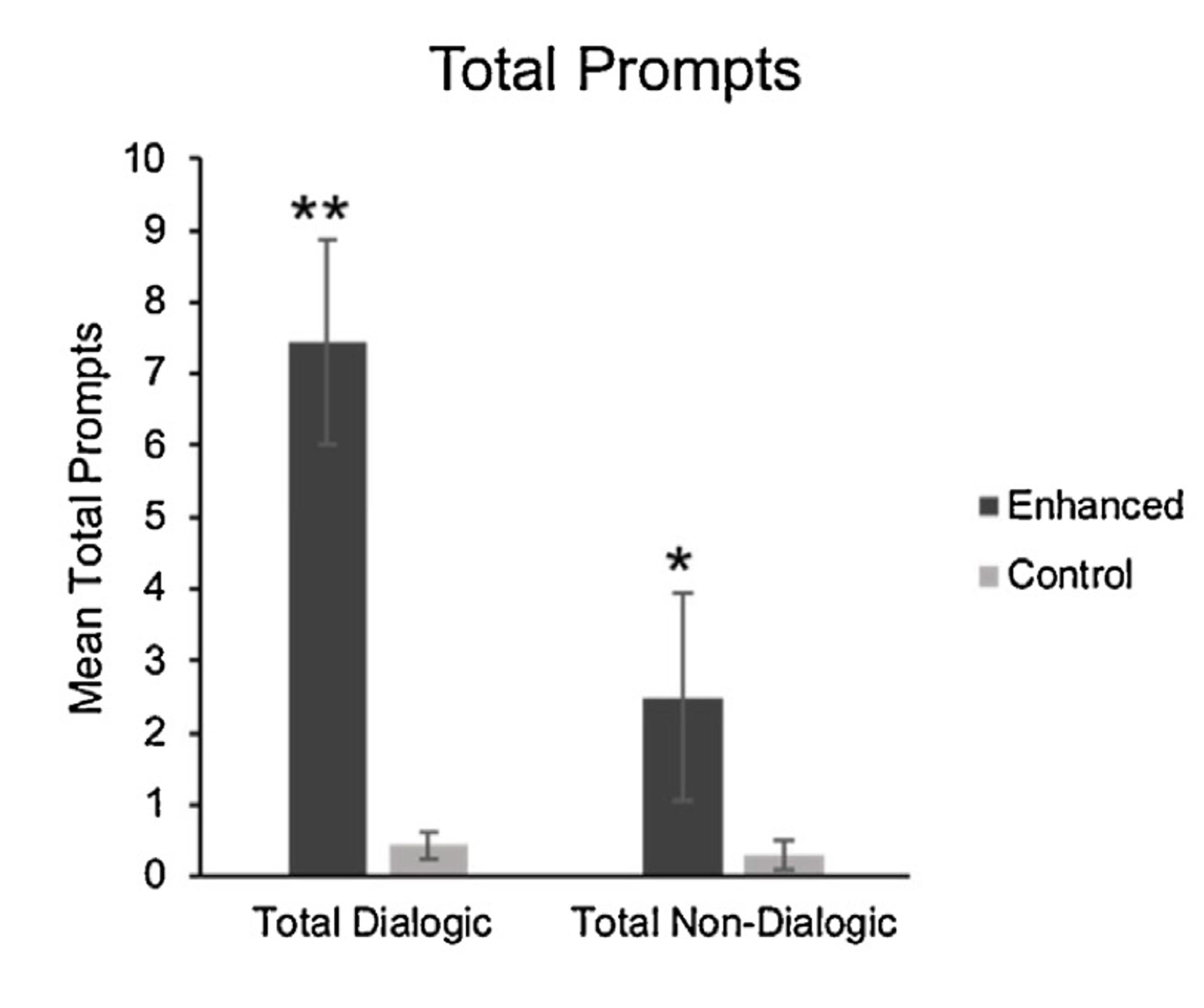
Based on research by Georgene Troseth, professor of psychology, emerita, the team feels confident that REED will have a positive impact. Troseth explored conversation prompts embedded in e-books and found this approach enhanced conversational exchanges and engagement. However, the technology could not be scaled in a cost-effective way—something Booth hopes to change with the REED mobile app.
“Capitalizing on AI to generate high-quality dialogic reading prompts for any book you could be interested in makes this a much more flexible and scalable solution,” Booth said. “We’re interested in improving children’s literacy and supporting caregivers in that process by offering an innovative, low-cost solution.”
The team is pursuing additional funding to launch COG Learning and expand their research on the use of AI to assist dialogic reading and strengthen literacy outcomes.