Featured Research
-

CNN Opinion: Has the NSA gone rogue?
Although the NSA may not conduct queries or examine content unless it or a court determines that “national security” is at stake, national security is apparently at stake quite often, if the recent reports about monitoring hundreds of thousands of foreigners’ calls as well as the calls of foreign leaders are true, writes Christopher Slobogin, Milton R. Underwood Professor of Law. Read MoreOct 31, 2013
-

Knowing who their physician is boosts patient satisfaction
Knowing who your doctor is — and a couple of facts about that person — may go a long way toward improving patient satisfaction, according to a Vanderbilt study in the Journal of Orthopaedic Trauma. Read MoreOct 31, 2013
-
Even in the dark, brain “sees” its own body’s movement
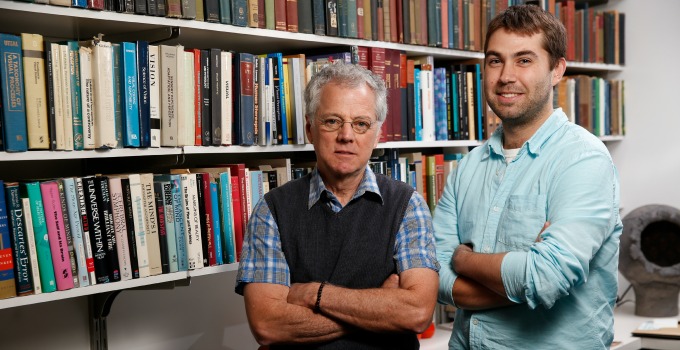
With the help of computerized eye trackers, new research finds that at least 50 percent of people can see the movement of their own hand even in the absence of all light. Read MoreOct 30, 2013
-
VUCast: A wireless capsule and hallucinating without drugs
See how a wireless capsule could help during minimally invasive surgeries Why magnesium and vitamin D are a match made in heaven And do you really see the S in the USA network logo? Watch this QuickVU roundup of research stories. [vucastblurb]… Read MoreOct 30, 2013
-

Vanderbilt to study use of plasma on LifeFlight
Vanderbilt University Medical Center will participate in a national trial to see if outcomes for critically injured patients with uncontrolled bleeding can be improved by administering plasma to these patients while in flight to the hospital. Read MoreOct 29, 2013
-
National Robotics Initiative grant will provide surgical robots with a new level of machine intelligence
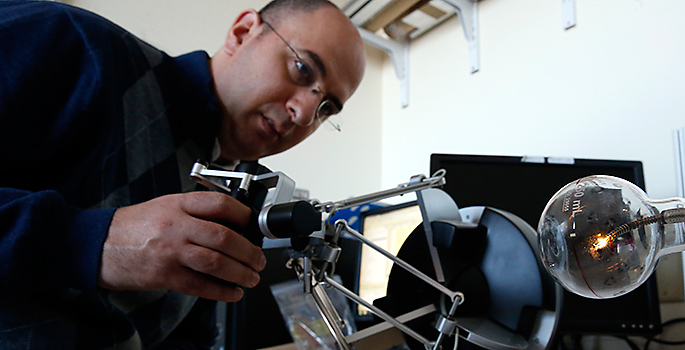
Providing surgical robots with a new kind of machine intelligence that significantly extends their capabilities and makes them much easier and more intuitive for surgeons to operate is the goal of a major new grant announced as part of the National Robotics Initiative. Read MoreOct 25, 2013
-

What makes math instruction in China more effective?
A $200,000 grant from the National Science Foundation will enable a team of U.S. and Chinese researchers to identify instructional supports that lead to higher levels of mathematics achievement. Read MoreOct 23, 2013
-

New device stores electricity on silicon chips
Solar cells that produce electricity 24/7. Cell phones with built-in power cells that recharge in seconds and work for weeks between charges: These are just two of the possibilities raised by a novel supercapacitor design invented by material scientists at Vanderbilt University. Read MoreOct 22, 2013
-

Theatre offers promise for youth with autism, Vanderbilt study finds
A novel autism intervention program using theatre to teach reciprocal communication skills is improving social deficits in adolescents with the disorder that now affects an estimated one in 88 children, Vanderbilt University researchers released today in the journal Autism Research. Read MoreOct 22, 2013
-

VIX creator calls Volatility ETPs ‘guaranteed losers’
Owen Graduate School of Management Professor Bob Whaley guarantees that an increasingly popular investment product that tracks the volatility of financial markets will lose money over the long term. Read MoreOct 18, 2013
-

Frog-killing fungus paralyzes amphibian immune response
A fungus that is killing frogs and other amphibians around the world releases a toxic factor that disables the amphibian immune response, Vanderbilt University investigators report Oct. 18 in the journal Science. Read MoreOct 17, 2013
-

Restoring surgeons’ sense of touch during minimally invasive surgeries
A team of engineers and doctors have developed a new wireless capsule that can give surgeons back their sense of touch when performing minimally invasive surgery. Read MoreOct 15, 2013
-

A revolution in astronomy: How we came to know what we know
Science has progressed from wild speculation about Earth’s planetary neighbors—including how they formed and whether they are inhabited—to a better understanding of our celestial neighborhood, David Weintraub, professor of astronomy, writes in "Scientific American." Read MoreOct 14, 2013
-

Chile could expect more protests: LAPOP
Analysts with Vanderbilt's LAPOP team say Chilean authorities might want to brace for more civil discord in that country. Read MoreOct 10, 2013
-

Live Science: Conservatives and liberals equally smug, study finds
New research by postdoctoral fellow Kaitlin Toner suggests liberals and conservatives are about equally convinced of the correctness of their views, but extremists are more likely than moderates to feel their views are superior. Read MoreOct 9, 2013
-

2013 ‘First to the Top’ survey findings on teacher evaluations released by Tennessee Consortium
Teachers and their observers viewed Tennessee’s teacher evaluation process more positively in 2013 than in 2012, according to a broad-based independent survey by the Tennessee Consortium on Research, Evaluation and Development at Vanderbilt’s Peabody College of education and human development. Read MoreOct 9, 2013
-

Attracting effective teachers may require new strategic initiatives
Large urban school districts may need to adopt new strategies to draw prospective teachers to the most disadvantaged and geographically isolated schools, according to research from Vanderbilt University to be published in an upcoming issue of the American Education Research Journal. Read MoreOct 1, 2013
-

Finding the place where the brain creates illusory shapes and surfaces
Neuroscientists have identified the location in the brain's visual cortex responsible for generating a common perceptual illusion: seeing shapes and surfaces that don't really exist when viewing a fragmented background. Read MoreSep 30, 2013
-
For secure health care data, thwart the attacks of tomorrow – not yesterday
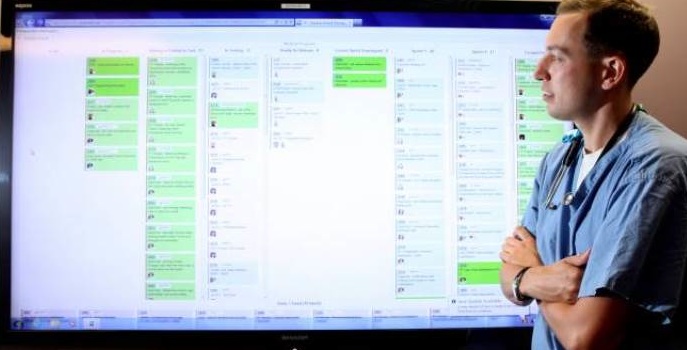
Proactive measures are the best way to stay ahead of computer hackers who threaten the security of digital health care records, says M. Eric Johnson, dean of Vanderbilt’s Owen Graduate School of Management. Read MoreSep 25, 2013
-

Group prenatal care led to improved birth outcomes
Women with access to group prenatal care had improved birth outcomes, including longer gestational periods and higher birth weight, in a study conducted by researchers at Vanderbilt’s Peabody Research Institute. Read MoreSep 19, 2013