Sandra Rosenthal
-

New study sheds light on seasonality in mood disorders
A recent study conducted by Vanderbilt chemistry professors Sandy Rosenthal and Oleg Kovtun found that people experiencing depressed states had lower daytime activity, and people’s daytime activity increased with longer days and more sun exposure. Read MoreOct 31, 2024
-

Rays of Hope: Depressive disorders with seasonal pattern influenced more by location, daily shifts in sunlight than average seasonal changes
New research from Sandra Rosenthal, Jack and Pamela Egan Professor of Chemistry and professor of pharmacology and chemical and biomolecular engineering, suggests that the rate of change in solar insolation—that is, the amount of solar radiation that reaches the ground over a specified time in a given location—has a greater impact on these depressive disorders than routine seasonal changes in sunlight. Read MoreJan 30, 2022
-

Take a Chair: A new $30 million investment to support faculty could lead to innovations that will save your life and shape the world’s future
In this feature, Vanderbilt Magazine highlights just a few of the wide-ranging research endeavors being undertaken by the university’s current chair holders—from the creation of low-cost, potentially lifesaving materials that can warn of structural failures to discoveries explaining the mechanisms of addiction. Read MoreNov 21, 2017
-

‘Flying saucer’ quantum dots hold secret to better, brighter lasers
Vanderbilt University chemists collaborated in research that ‘squashes’ the shape of nanoparticles to create inexpensive lasers that continuously emit light in a customizable rainbow of colors. Read MoreMar 20, 2017
-
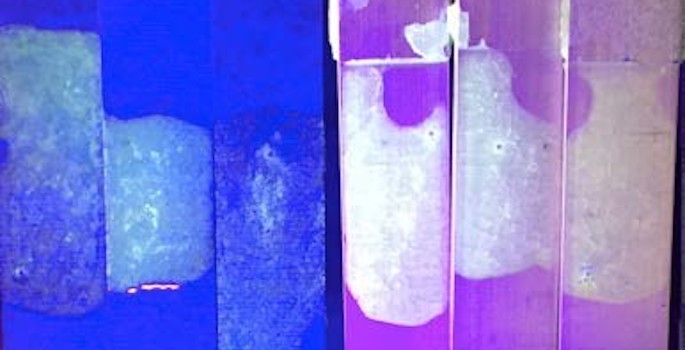
Mood ring materials – a new way to detect damage in failing infrastructure
"Mood ring materials" constitute a new type of smart sensing technology that could play an important role in minimizing and mitigating damage to the nation's failing infrastructure. Read MoreNov 21, 2016
-
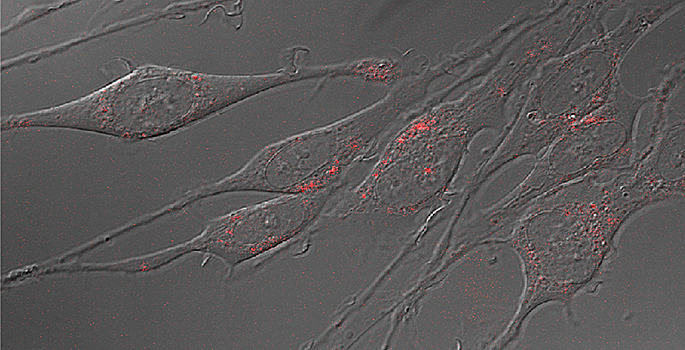
Probing the roots of depression by tracking serotonin regulation at a new level
An interdisciplinary team of scientists have successfully tagged a protein that regulates the neurotransmitter serotonin with tiny fluorescent beads, allowing them to track the movements of individual molecules for the first time. This capability makes it possible to study the manner in which serotonin regulates mood, appetite and sleep at a new level of detail. Read MoreJun 27, 2012
-

Quantum dots brighten the future of lighting
Vanderbilt researchers have boosted the efficiency of a novel source of white light called quantum dots more than tenfold, making them of potential interest for commercial applications. Read MoreMay 8, 2012
-
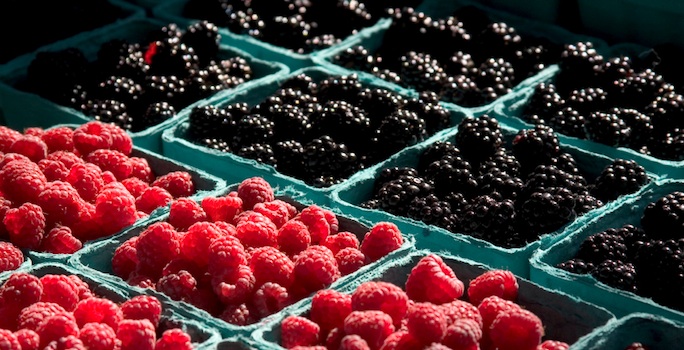
High school students turn blackberries into solar cells
VINSE is starting new high school field trip program where they will have students create a solar cell out of blackberries and raspberries. Read MoreMar 21, 2012
-
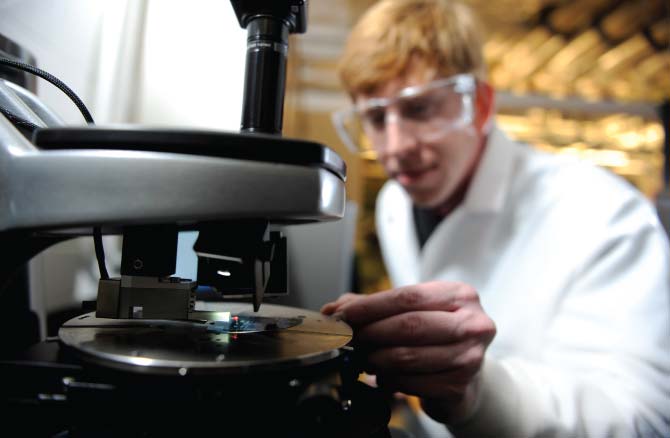
Something big from something small: The 10th anniversary of VINSE
Vanderbilt researchers working at the smallest scale celebrate a huge milestone this year. The Vanderbilt Institute of Nanoscale Science and Engineering (VINSE), seeded from a university-funded $16 million venture capital fund initiative, celebrates its 10th anniversary in December. Read MoreDec 13, 2011
-
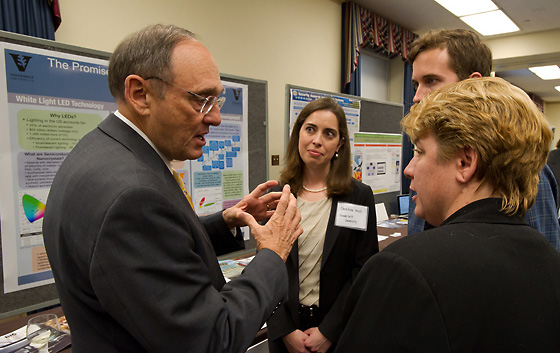
Prof. Rosenthal goes to Washington
Representative Phil Roe (R-TN) chatting with Prof. Sandra Rosenthal, front, graduate student Scott Niezgoda and Christina West, assistant vice chancellor of federal relations, in Washington D.C. at the 17th annual CNSF Exhibition & Reception. (David Scavone) Last Wednesday, Sandra Rosenthal and Scott Niezgoda accepted the invitation… Read MoreMay 13, 2011
-

Video: “Promise of Nanotechnology: Unique new properties that can be tailored and controlled to solve challenges in our world”
Watch a talk by Sandra Rosenthal, professor of chemistry. Read MoreMay 22, 2009