NSF
-

NSF research grant goes to 16 Vanderbilt graduate students
The grant program is aimed at aiding individuals who have demonstrated notable potential early in their research career, as well as promoting diversity in the sciences. Read MoreApr 8, 2015
-
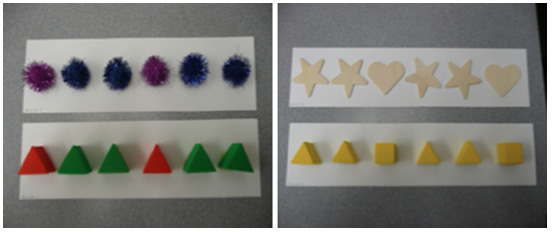
Abstract language may help preschoolers grasp early math concepts
Minor differences in language can have a large effect on how children think about learning materials, including the objects that make up a pattern. Read MoreFeb 3, 2015
-

Vanderbilt team builds miniature capsule robots, heads to NSF I-Corps
Pietro Valdastri, assistant professor of mechanical engineering and electrical engineering, and postdoctoral scholar Ekawahyu Susilo will begin Valdastri’s second run as principal investigator in the NSF I-Corps program as they explore the commercial potential of modular open-source architecture for building capsule robots. Read MoreJan 13, 2015
-

Electrical stimulation ‘tunes’ visual attention using long-term memory
Picking a needle out of a haystack might seem like the stuff of fairytales, but our brains can be electrically “tuned” to enable us to do a much better job of finding what we’re looking for. Read MoreJan 7, 2015
-

How the hummingbird achieves its aerobatic feats
The most detailed aerodynamic simulation of hummingbird flight conducted to date demonstrates that it achieves its aerobatic abilities through a unique set of aerodynamic forces. Read MoreNov 21, 2014
-

Life’s extremists may be an untapped source of antibacterial drugs
A family of single-celled organisms that thrive in environments too extreme for most other species to survive may be an untapped source of new antibacterial drugs. Read MoreNov 21, 2014
-

Improving breast cancer chemo by testing tumors in a dish
A team of biomedical engineers has developed a new "tumor-in-a-dish" technology that promises to improve the effectiveness of chemotherapy. Read MoreOct 28, 2014
-

Research Roundup, Summer 2014
Private Property and Government Inaction | Probiotic Could Prevent Obesity | Freedom from Power Cords | Pickiness Doesn’t Always Pay Read MoreSep 26, 2014
-

Treatments for frog fungus
The fungicide amphotericin B may be a useful treatment for a frog fungus that is killing amphibians worldwide. Read MoreJul 25, 2014
-
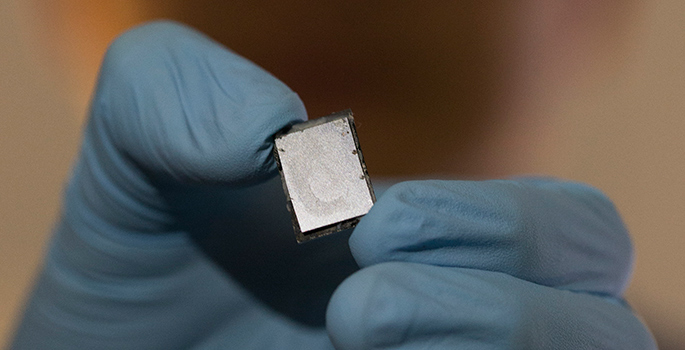
Liberating devices from their power cords
A new type of supercapacitor brings us a step closer to a day when everything from cell phones to electric vehicles will no longer need separate batteries. Read MoreMay 19, 2014
-

Electric “thinking cap” controls learning speed
Vanderbilt psychologists show it is possible to selectively manipulate our ability to learn through the application of a mild electrical current to the brain, and that this effect can be enhanced or depressed depending on the direction of the current. Read MoreMar 21, 2014
-

Nanoscale optical switch breaks miniaturization barrier
An ultra-fast and ultra-small optical switch has been invented that could advance the day when photons replace electrons in the innards of consumer products ranging from cell phones to automobiles. Read MoreMar 13, 2014
-

Valentine receives NSF Early Career award
Assistant Professor of Mechanical Engineering Jason Valentine has received a National Science Foundation Faculty Early Career Development grant. Read MoreFeb 20, 2014
-

Baby hearts need rhythm to develop correctly
The mechanical forces generated by the rhythmic expansion and contraction of cardiac muscle cells play an active role in the initial stage of heart valve formation. Read MoreFeb 18, 2014
-

In the brain, the number of neurons in a network may not matter
A study has found that the time it takes neural networks in the brain to make decisions is remarkably stable regardless of size: a finding that could make it easier to achieve the goal of the President's BRAIN Initiative established last spring. Read MoreFeb 3, 2014
-

Math models to aid voice disorders
A new computational model of the interactions between vocal folds and the air around them could aid in designing new treatments for voice disorders. Read MoreJan 27, 2014
-

Surprising new class of “hypervelocity stars” discovered escaping the galaxy
Two Vanderbilt astronomers are among an international team that has discovered a surprising new class of “hypervelocity stars” – solitary stars moving fast enough to escape the gravitational grasp of the Milky Way galaxy. Read MoreJan 9, 2014
-

Study gives new meaning to ‘let your fingers do the walking’
A new study has found that skilled typists can’t identify the positions of many of the keys on the QWERTY keyboard and that novice typists don’t appear to learn key locations in the first place. Read MoreDec 4, 2013
-
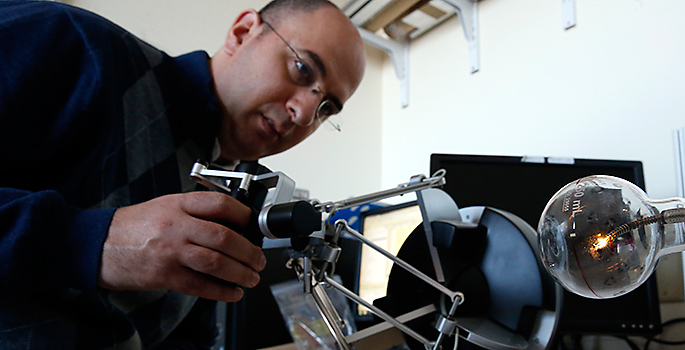
National Robotics Initiative grant will provide surgical robots with a new level of machine intelligence
Providing surgical robots with a new kind of machine intelligence that significantly extends their capabilities and makes them much easier and more intuitive for surgeons to operate is the goal of a major new grant announced as part of the National Robotics Initiative. Read MoreOct 25, 2013
-

What makes math instruction in China more effective?
A $200,000 grant from the National Science Foundation will enable a team of U.S. and Chinese researchers to identify instructional supports that lead to higher levels of mathematics achievement. Read MoreOct 23, 2013