Vanderbilt University served as the convening host for a major World Economic Forum gathering on Monday, Nov. 10, bringing leaders from government, industry, academia and civil society to Nashville for a full day of discussion on how states and regions can navigate a rapidly changing national and global environment. The program, “Regional Leadership in a New Global Context,” explored emerging trends shaping the future of workforce development, energy, health care, technology and national security.
The forum is part of Vanderbilt’s deepening engagement with global issues and its expanding role as a nexus for policymaking, research and innovation. Sessions were held at Vanderbilt’s Carmichael College and aligned with the university’s mission to foster informed dialogue and strengthen connections among leaders shaping the future of their fields.
High-level program explores the forces reshaping America
The day began with a networking breakfast and a joint welcome from Paul Smyke, head of the regional agenda at the World Economic Forum, and Darren Reisberg, Vanderbilt’s vice chancellor for administration. Nathan Green, vice chancellor for government and community relations, introduced Tennessee Gov. Bill Lee, who delivered opening remarks on how states can position themselves as engines of growth and innovation amid shifting political and economic dynamics.
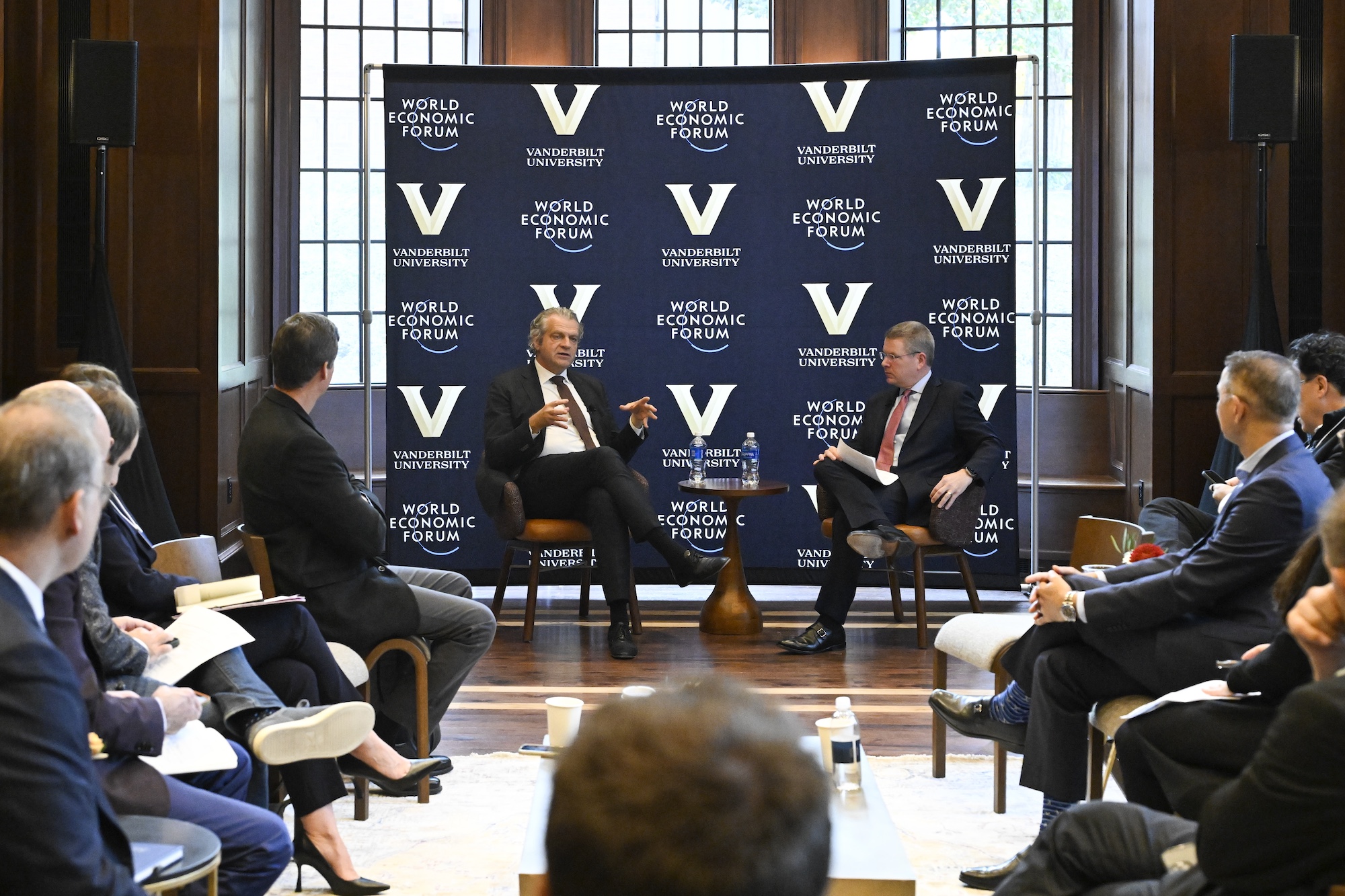
Chancellor Daniel Diermeier then joined Sam Feist, BA’91, CEO of C-SPAN, for a wide-ranging conversation on the state of higher education. Their discussion examined how universities can maintain trust, champion free expression and play a vital role in preparing the next generation of leaders. A robust audience-led Q&A followed, reflecting strong interest in Vanderbilt’s leadership in higher-education reform.


Panels highlight AI in health care, workforce development and the future of energy
Throughout the day, attendees participated in sessions featuring senior officials from state governments, national health leaders, executives of major corporations and academic experts.
In the “AI Prescription for Healthcare” session, the opportunities and risks of artificial intelligence in medicine were discussed by panelists including state health secretaries from North Carolina, Illinois and Wisconsin; leaders from Vanderbilt University Medical Center; and senior industry executives. The conversation focused on innovation, patient trust, governance and strategies for scaling the impact of health AI through effective public-private collaboration.
The “Future-Proofing America’s Talent Pipeline” panel examined how states can respond to accelerating technological change and evolving labor market needs. Participants emphasized the importance of aligning workforce development with emerging economic sectors, strengthening pathways from learning to employment and fostering cross-sector partnerships to reduce talent shortages.
In “Building America’s Future Energy,” leaders from across the energy landscape—spanning private companies, state energy agencies and academia—explored how the U.S. can meet rising energy demand and transition to a more secure, affordable and sustainable system. Discussions addressed infrastructure expansion, state-federal regulatory dynamics and the role of industry in accelerating innovation.
Jon Meacham offers a historical perspective

During a working lunch, Pulitzer Prize–winning historian and Vanderbilt professor Jon Meacham led a timely discussion of the current political moment and how the nation has navigated past periods of upheaval. Meacham reflected on what he has described as a moment when Americans are debating not only the mechanisms of politics but its very purpose—placing today’s challenges within the broader arc of U.S. history. C-SPAN covered Meacham’s remarks on their network.
Concluding panel discusses environment of rising national security threats
The day concluded with a panel on the increasingly complex U.S. security landscape, moderated by Julian Barnes of The New York Times. Leaders in cybersecurity, biosecurity, public affairs and national defense examined emerging threats facing states—from infrastructure vulnerabilities to geopolitical tensions—and identified opportunities for collaboration across government and the private sector.
The conversation continues
The program closed with reflections from Vanderbilt and World Economic Forum representatives, who emphasized the importance of ongoing collaboration across sectors to shape a more resilient and prosperous future.