






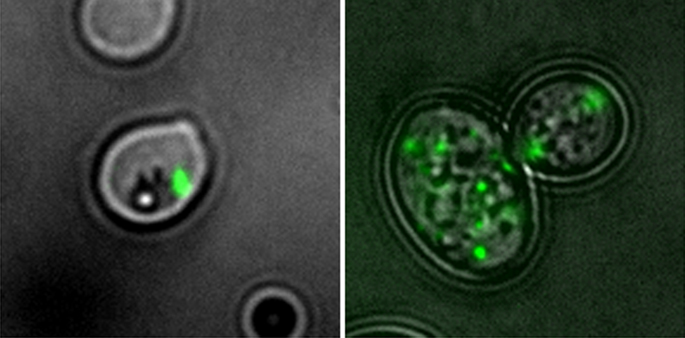
The yeast Saccharomyces cerevisiae – used for thousands of years in bread baking and alcohol brewing – is a valuable model for understanding fundamental cellular processes, such as how genomic information is translated into proteins. In a screen of S. cerevisiae translation initiation factors – factors required to start protein synthesis from a messenger RNA code – Andrew Link, Ph.D., associate professor of Pathology, Microbiology and Immunology, and colleagues have discovered an unusual pairing.
They report in the March issue of Molecular and Cellular Biology that eIF2B – an initiation factor complex of five protein subunits – physically interacts with an enzyme (YBR159W) that generates very-long-chain fatty acids. The researchers used affinity purification coupled with mass spectrometry and yeast two-hybrid assays to demonstrate the interaction. A yeast strain missing YBR159W has slow growth and a reduced translation rate, and causes a change in eIF2B cellular location.
The functional role of the interaction between eIF2B and YBR159W is unclear – one pathway might regulate the other or the two factors could be engaged in a novel function, the investigators suggest.
This research was supported in part by grants from the National Institutes of Health (AI007611, GM064779).