


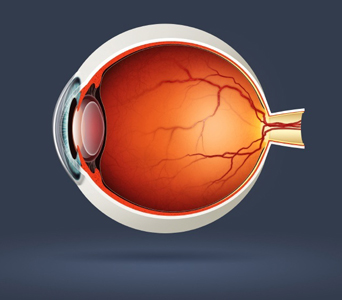
Loss of photoreceptor cells (special neurons in the retina that convert light into biological signals) may be caused by defects in the response of the light receptor rhodopsin. Light-activated rhodopsin normally interacts with the protein arrestin, which inactivates rhodopsin signaling. But a persistent complex between the two can lead to internalization and degradation of rhodopsin, and degeneration of photoreceptors.
Bih-Hwa Shieh, Ph.D., associate professor of Pharmacology, and colleagues explored the contribution of phosphorylation (a chemical modification) of rhodopsin and arrestin to retinal degeneration in fruit flies. Using a fluorescence-tagged arrestin to monitor rhodopsin turnover and photoreceptor degeneration, they found that the phosphorylation status of arrestin had no consequence on retinal morphology. They discovered that excessive phosphorylation of rhodopsin, however, plays an integral role in initiating degeneration of photoreceptors.
The findings, reported in the Aug. 1 Journal of Neuroscience, suggest that it may be possible to treat retinal degeneration that results from rhodopsin-arrestin complex formation by reducing rhodopsin phosphorylation.
This research was supported by grants from the National Eye Institute (EY019519, EY008126) of the National Institutes of Health.